The Wine Drawer Edit: What Earns Its Place, and What Can Go
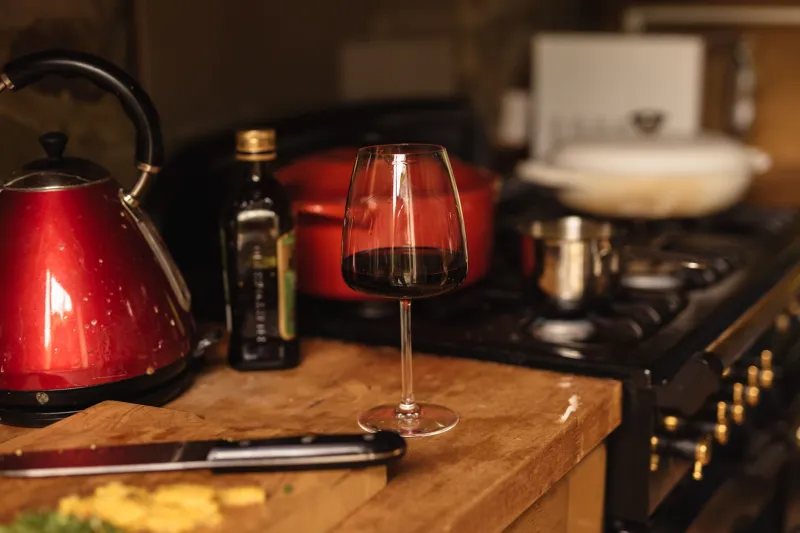
There is a particular kind of November evening — dark by five, something braising, a bottle open on the counter — that makes you grateful for a short wine list and a short kit list. The trouble is that most of us have the opposite: a cupboard full of glassware that seemed sensible at the time, and a nagging feeling that the one glass we actually want is at the back, slightly dusty.
This is not a piece about spending money. It is a piece about subtraction. A wine drawer, not a wine cabinet.
Start With the Glass You Actually Reach For
If you own one good all-purpose wine glass, you own more than most dinner parties need. Look for a bowl that is broad enough to let a red breathe but tapered enough to keep a white lively. A stem gives you somewhere to hold the glass without warming the wine; a thin rim makes the whole business feel less like a dental appointment. You do not need a different shape for every grape. You need a glass that does not fight the wine.
In the UK, where our houses are often small and our cupboards are shallower than the photographs suggest, this matters. A set of six sturdy all-purpose glasses will serve a Sunday roast, a midweek pasta, a bottle of English sparkling and the odd sherry. They will survive the dishwasher if you treat them kindly, and they will not make you wince when a guest tops up with enthusiasm.
The fancy glasses can stay if you genuinely use them. But be honest: when did you last reach for the enormous Burgundy balloon on a Tuesday? If the answer is never, it is not kit. It is decoration.
The Jug Is the Unsung Hero
A plain glass jug is the most useful thing in the wine drawer after the glasses themselves. It decants, it breathes, it catches sediment, it holds water for the table, and it doubles as a vase when someone turns up with flowers. A cheap one is fine. A slightly ugly one is fine. What matters is that it is clean, stable and easy to pour from.
You do not need a crystal decanter with a stopper that never quite fits. You need a jug you can rinse in hot water and leave to drain without a special brush. If a young red is a bit tight, pour it into the jug and give it ten minutes. If an older bottle has sediment, pour slowly and stop when the grit arrives. If the wine is fine as it is, leave it alone. The jug is not a ceremony; it is a tool.
The Things That Quietly Waste Space
Let us be polite but firm about the rest. Mismatched decanters, novelty stoppers, champagne flutes, electric aerators, wine charms, and the corkscrew that only works on the second attempt: these are the items that colonise the cupboard and contribute very little.
Flutes are the classic example. They look festive, but they are poor dinner companions. The narrow bowl concentrates the bubbles and hides the aroma, which is a shame when you have spent good money on a bottle. A decent all-purpose glass will flatter sparkling wine more than a flute will. Save the flutes for the toast if you must, but do not build a wine kit around them.
Novelty stoppers are another quiet offender. They seal badly, they get lost, and they make the bottle look like a souvenir. A simple rubber stopper or the original cork will do. And the mismatched decanter you inherited? If it is hard to clean and impossible to store, it is not an heirloom. It is a shelf-hog.
Washing, Storing, and the Two-Minute Rule
The best kit is the kit you will actually wash. A glass that needs hand-polishing with a linen cloth and a steady hand is a glass that will sit in the sink until morning. Choose glasses that fit in your washing-up bowl or your dishwasher, and choose a jug that does not require a bottle brush with a bendy neck.
Store glasses upright if you can, and keep them away from the onion-and-garlic end of the cupboard. Glass picks up smells. A quick rinse with hot water before pouring is often enough; detergent residue is the enemy of a decent head on a beer and a decent aroma in a wine. Dry them upside down on a clean tea towel, or leave them to air.
The two-minute rule is simple: if a piece of kit takes longer to wash than it does to use, it will not earn its place. That goes for decanters, aerators and anything with a fiddly stopper.
The Tuesday Supper Test
Before anything new comes into the wine drawer, apply the Tuesday supper test. Will it make a convivial Tuesday supper better — not a photograph, not a dinner party you have been planning for three weeks, but an ordinary evening with a pot of something on the hob and a bottle open on the table? If the answer is no, leave it in the shop or take it to the charity shop.
The best wine kit is not the most impressive. It is the most used. Two good glasses, one plain jug, a decent corkscrew and a clean tea towel will flatter more bottles than a cabinet of specialised shapes. And they will leave you with more room for the things that actually matter: the food, the company, and the second glass you did not plan to pour.