The Sunday Roast Wine Rack: Six Bottles That Earn Their Place, and One That Doesn't
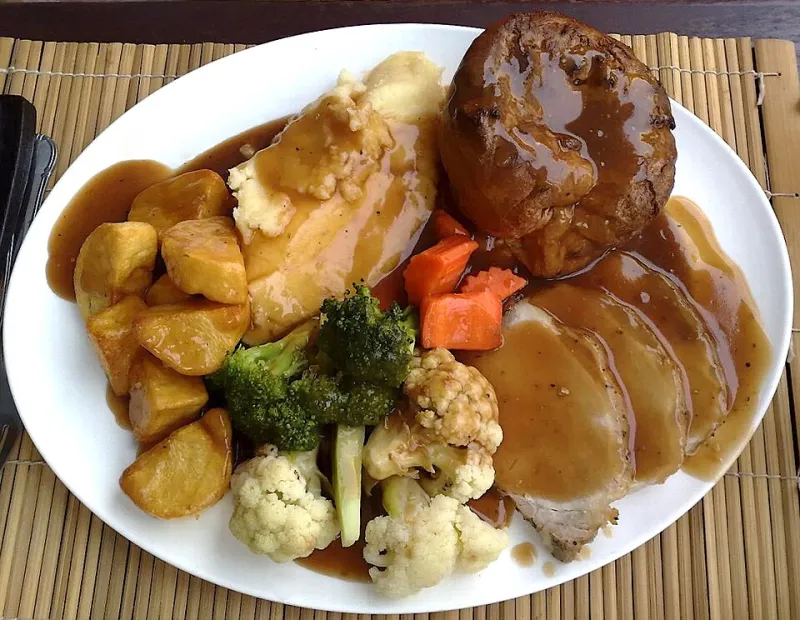
Photo: Jeff McNeill, CC BY-SA 2.0, via Wikimedia Commons
The Sunday roast isn't one dish. It's a plate of small disagreements: salty gravy against sweet carrots, bitter sprouts against buttery mash, crackling against bread sauce, and a Yorkshire pudding that exists mainly as a delivery system for more fat. Pairing wine to that is a different job from pairing wine to a steak, and the usual instincts — big red, buttery white — tend to make the whole thing taste muddier than it did before you opened the bottle.
Three things on the plate that fight back
Salt, fat and bitterness. Gravy brings the first two in quantity, and the roast potato brings the third in spirit if not in flavour. Acid is the tool that cuts through fat and refreshes the palate between mouthfuls; tannin and oak are not. A tannic red grips the salt in the gravy and can turn oddly metallic against brassicas. An oaky white goes sweet and vanilla-scented the moment the gravy arrives, and the sprouts start tasting like a chore.
So the rule for the roast is freshness first, structure second. You want wines with enough acidity to reset your palate every few bites, and enough body to stand up to a plate that is, frankly, quite rich.
Six bottles to work through
1. Mâcon-Villages or a lightly oaked Chardonnay — for roast chicken, £12–16
Chicken is the gentlest roast on the list and the one most often over-matched. A white Burgundy from the Mâcon is the obvious, unfussy answer: green apple, a little hazelnut, a soft creamy edge from old oak rather than new. It flatters the bird, copes with tarragon or lemon stuffing, and doesn't collapse when the gravy hits the plate. Look for the word élevé en fût de chêne if you want a touch more weight.
2. Chinon or a cool-climate Cabernet Franc — for roast beef, £12–15
Everyone reaches for Bordeaux or a blockbuster Shiraz with beef. Try a red from the Loire instead. Cabernet Franc grown in a cool climate gives you redcurrant, graphite and a leafy edge, with tannins that are present but polite — fine enough to sit alongside rare meat without scraping the palate. It also handles horseradish, which is more than most reds can say.
3. Crozes-Hermitage or a northern Rhône Syrah — for roast lamb, £15–18
Lamb wants pepper and a bit of savoury depth, and Syrah from the northern Rhône delivers exactly that: blackberry, cracked black pepper, a whiff of something meaty and iron-like. Crozes-Hermitage is the value pick of the region. It's got enough grip for the fat on a shoulder of lamb, and enough freshness that the mint sauce doesn't derail it. Decant for half an hour if you've got the time — it opens up considerably.
4. Beaujolais-Villages — for nut roast and the veg-forward plate, £10–13
Nut roast is a hard assignment: earthy, crumbly, often a bit sweet, and easily bullied by anything tannic. Gamay is the fix. Beaujolais-Villages brings bright cherry, a faintly granitic snap and almost no tannin, so the lentils and the cashews get to taste of themselves. Serve it very slightly chilled — fifteen minutes in the fridge does it no harm at all.
5. Dry English sparkling — for the Yorkshire puddings, £22–28
This is the one people raise an eyebrow at, and then stop raising it once they've tried it. Bubbles and batter are an excellent match: the acidity scrubs the fat, the mousse lifts the salt, and the whole table gets louder in the best way. A dry English sparkling from Kent or Sussex does the job beautifully and is a far more interesting opening than another warm glass of something white. Open it while the joint rests.
6. Grüner Veltliner or a dry Riesling — for the sprouts, £12–15
Sprouts, cabbage, leeks, any of the brassicas: these are the vegetables that make red wine taste sour. A peppery, dry white with real acidity handles them without fuss. Grüner Veltliner is the textbook answer — white pepper, lime, a texture that's fuller than it looks — and an off-dry Riesling from the Mosel will convert anyone who thinks they don't like the grape. Buy one bottle of this for every four people and watch it disappear.
The bottle that ruins the roast
The one to leave on the shelf is the big, oaky, high-alcohol red — the sort of 14.5% or 15% Shiraz or heavily oaked Cabernet that's been aged in a forest of new barrels. It isn't a bad wine. It's just the wrong wine for this plate. The alcohol reads as heat against the gravy, the oak turns bitter alongside the sprouts, and the tannin — designed to cut through a slab of rare protein — instead numbs your palate somewhere around the second Yorkshire pudding. Everything after it tastes like nothing, which is a grim fate for a meal you've spent four hours on.
The same logic applies, gently, to heavily oaked whites. Save those for a roast bird with a cream sauce, not for a plate swimming in gravy.
If you're only opening one bottle
Pick the Chinon or the Mâcon, depending on whether the table leans red or white. Either will carry you from the first slice to the last sprout without a single grimace, and both come in comfortably under twenty pounds — which leaves room for a decent pudding wine if the afternoon goes the way Sundays usually do.
One last thing: serve your reds cool. Fifteen or sixteen degrees, not the twenty-odd of a warm dining room. Ten minutes in the fridge before pouring makes a modest red taste considerably more expensive than it is. That's the sort of trick we're always happy to pass on.